
Companies operating in regulated and highly distributed environments face a paradox: they need to accelerate, but they cannot lose control.
Automation is often presented as the answer to operational efficiency. However, as organizational complexity grows with multiple systems, microservices, APIs, regulatory rules and interdepartmental dependencies, isolated automation is no longer enough.
What becomes necessary is orchestration.
In a recent episode of NT Talks, Carlos Simidu, Head of Automation and Platforms at F1RST (Santander Group), shared lessons learned on how to structure automation with technical maturity and governance in complex environments.
Listen to the full episode on Spotify (in Portuguese):
Why is orchestration so essential in the current landscape?
The majority of corporate initiatives start with point automations:
• Scripts to reduce repetitive tasks
• Bots for interaction with legacy systems
• Integrations via API
• Self-healing for automatic incident remediation
These initiatives solve local problems. But enterprise environments are made up of interdependent flows.
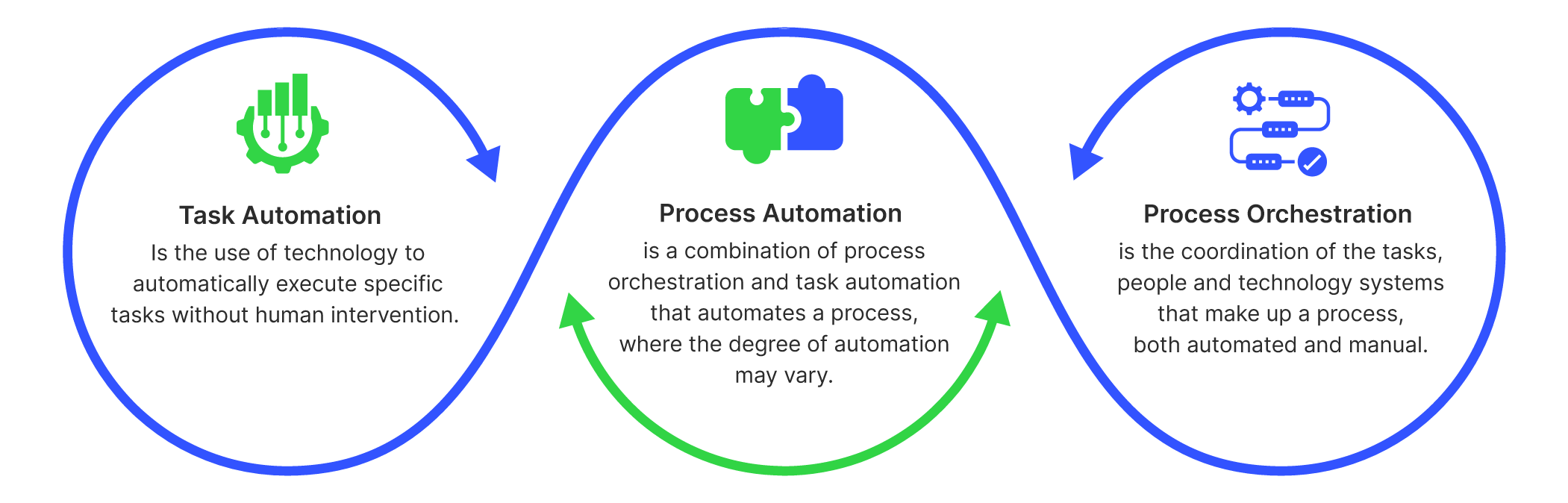
Orchestration goes much further, involving the management of complex workflows and interdependent tasks across multiple systems and teams. It ensures that each stage of a business process is executed in the correct sequence, at the right moment, and with the appropriate resources.
This is how orchestration helps organizations work with the people, systems, and devices they already have, while still achieving the most ambitious goals in terms of end-to-end process automation.
In simple and direct terms:
The impact of growing complexity
According to the report Predictions 2026: Automation And Robotics¹, published by Forrester, the maturity of enterprise automation will enter a new phase by 2026: leading organizations will stop treating automation as a set of isolated initiatives and will begin structuring integrated frameworks that combine deterministic automation, cognitive capabilities, and end-to-end governance, all orchestrated to work in synergy.
Forrester highlights that technological fragmentation and the lack of structured orchestration are currently the main constraints on automation ROI, especially in environments with multiple distributed systems and a high degree of operational interdependence.
In modern architectures, where microservices, APIs, and events coexist with human decisions and regulatory rules, it is not enough to automate tasks: it is necessary to coordinate states, sequences, and exceptions over time.
Source¹: Predictions 2026: Automation And Robotics | Forrester
Camunda and orchestration
Platforms like Camunda emerge precisely to address this scenario.
By using BPMN as a modeling standard, the organization gains:
- Explicit, visible,and versioned processes
• Separation between business rules and execution code
• Support for long-running processes (days or months)
• Structured exception handling
• Full observability of instances
This is especially relevant in financial environments, where traceability and auditability are vital.
When flow logic is only in the code, any change requires deep technical intervention.
When the flow is modeled and orchestrated, changes can be controlled with lower risk and greater governance.
Overcoming a classic challenge: how to define the priority of processes to be automated?
One of the most critical points discussed in the podcast with Carlos Simidu was the risk of automating processes that have never been reviewed. Automation amplifies the existing structure. If a process contains:
• Redundant approvals
• Reports that do not lead to decisions
• Steps created by organizational inheritance
Automating this flow only accelerates waste.
Lean culture is a technical prerequisite, not just a philosophical one.
Before orchestrating, it is necessary to eliminate. This reduces:
• Operational latency
• Unnecessary resource consumption
• Architectural complexity
Check out this short from the episode on our YouTube in which Carlos Simidu explains the topic:
Governance and lifecycle: real maturity
Most organizations measure the creation of automations. Few measure obsolescence.
Structural questions:
- Who is responsible for this automation?
- Does it still generate value?
- Is there active monitoring?
- Is there a decommissioning plan?
Maturity means:
- Process versioning
- Observability
- Structured logs
- SLA indicators
- Periodic reviews
- Sunset policy
Without this, automation becomes a new layer of complexity.
Overcoming the challenge of automating inefficient processes starts with a reversal of logic: before asking “how to automate?”, it is necessary to ask “why does this process exist and what value does it generate?”.
Automating a flow without reviewing it only crystallizes waste and amplifies bottlenecks. The mature approach combines process analysis (end-to-end mapping), identification of redundant steps, review of business rules, and elimination of activities that do not add value.
Practices such as Lean and variability analysis help reveal where there is rework, unnecessary waiting, excessive approvals, or data generation with no real use. Only after this structural cleanup should automation be implemented.
Defining the order of priority for automation and orchestration requires objective criteria, not technical impulse.
A simple and effective matrix combines three dimensions:
- Business impact (volume, risk, revenue or cost)
- Operational complexity (number of systems involved, dependencies, variability)
- Execution frequency
Complexity requires method and leadership
Automation cannot be treated as a one-off initiative or a tactical fix. It must be structured with process clarity, technical leadership, architectural discipline, and continuous governance.
Organizations that understand this difference stop chasing the sheer volume of automations and start building a sustainable foundation of efficiency and control. If this is a strategic topic for your company, it is worth going deeper into the discussion and exploring how to structure a truly mature automation journey.
Get in touch with our team of specialists and let’s work together to help your organization automate and orchestrate with clarity and high ROI.