
When we talk about process automation, many organizations are still operating with a logic that is starting to fall behind. Predictable flows, fixed rules, linear execution...
This model worked well for years. Today, however, companies are dealing with distributed architectures, multiple systems, real-time data-driven decisions, and increasingly, AI agents that do not follow deterministic paths.
The challenge is no longer about automating tasks, but about orchestrating decisions.
It is in this context that the release of Camunda 8.9 should be understood.
What really changes with Camunda 8.9
At first glance, the release brings relevant technical improvements. But the core value is not in the individual features.
Camunda 8.9 addresses three historical barriers in process orchestration:
- Reduces adoption friction in enterprise environments
- Expands the ability to handle dynamic, event-driven processes
- Prepares the platform to operate in scenarios involving artificial intelligence and autonomous agents
In practice, this repositions the role of orchestration within organizations.
It is no longer just a technical component, but a strategic layer for business coordination.
Today, many companies operate with systems that work well in isolation, but fail when they need to act in a coordinated way. Orchestration emerges as the layer responsible for connecting these pieces, ensuring consistency, traceability, and operational flow.
When properly implemented, it reduces dependencies between teams, minimizes rework, and enables business decisions to be executed with greater predictability and control.
If you want to understand what the Camunda platform is, how it works, and why leading organizations choose it to orchestrate their critical processes, visit our complete Camunda platform page.
Frictionless infrastructure: the impact of RDBMS support
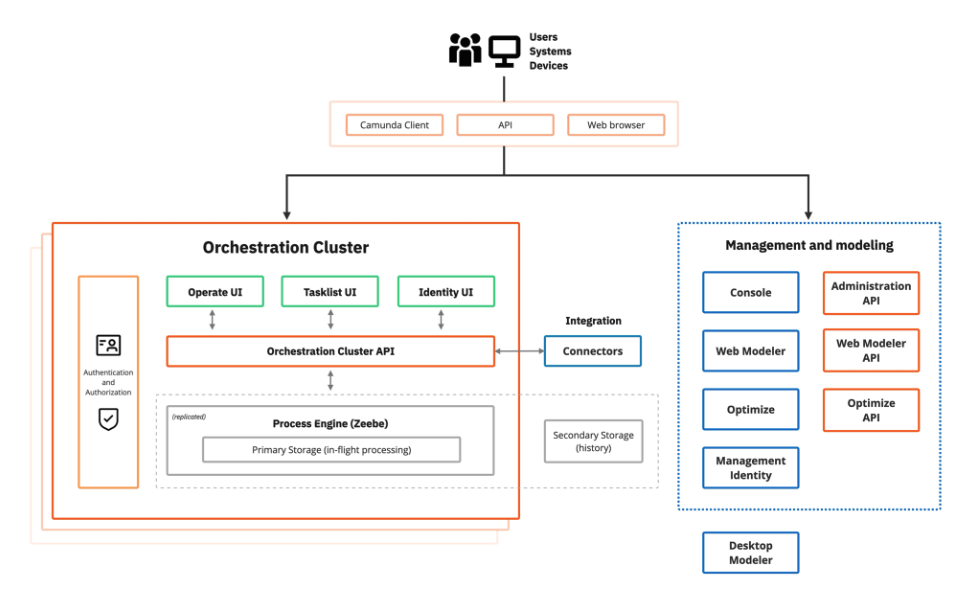
One of the most significant changes in Camunda 8.9 is the full support for relational databases as secondary storage. More than technical flexibility, this solves a real adoption challenge.
Until now, the need to operate with Elasticsearch or OpenSearch created barriers for many organizations, especially in regulated environments or those with strict infrastructure standards.
With support for PostgreSQL, Oracle, SQL Server, MySQL, and MariaDB:
- Operations teams can work with technologies they already know
- Existing practices for backup, monitoring, and security remain valid
- Architectural complexity is significantly reduced
- Time to go-live is shortened
In many cases, the biggest cost of a platform lies in the operational complexity it introduces. The need to maintain search clusters, specialized teams, and new operational standards directly impacts the total cost of ownership. By enabling the use of well-established relational databases, Camunda 8.9 reduces this structural complexity and brings orchestration closer to the operational reality of organizations, making large-scale adoption more feasible.
This shift transforms Camunda from a “strong technical choice” into a strong strategic choice from both an organizational and technical perspective. A detail that makes all the difference, as it significantly accelerates adoption.
Before provisioning, choose whether to use a shared database or separate databases for each component.
Aspect | Shared database | Separate databases |
|---|---|---|
Use case | Small deployments, unified DBA team | Large production, multi-team environments |
Setup | Single instance with different schemas/databases for OC and Web Modeler | Independent instances per component |
Pros | Simplified administration, single backup policy | Independent scaling, isolated credentials, easier troubleshooting |
Cons | Shared resources, requires schema/database separation | Additional operational overhead, higher infrastructure costs |
Both topologies are fully supported. Choose based on your organizational model and scaling needs.
BPMN evolves: from linear flows to reactive systems
Another critical advancement is the support for conditional events in BPMN. It may seem like an incremental improvement. It is not.
Traditionally, processes modeled in BPMN follow predictable paths. Even when there are variations, they are defined in advance.
With conditional events, the process starts reacting to real-time data.
This enables:
- Interrupting flows based on context changes
- Dynamically redirecting executions
- Automatically scaling decisions
- Integrating asynchronous responses (including AI)
In practice, BPMN no longer represents just flow. It becomes a living system of orchestrated decision-making.
This advancement also directly impacts application architecture. Instead of distributing business rules across multiple services, many of these decisions are now centralized and governed within the process model itself. This reduces coupling, simplifies maintenance, and improves visibility into overall system behavior.
In event-driven architectures, this ability to dynamically react to state changes becomes essential for maintaining consistency and resilience.
It reduces the need for logic scattered across code and brings greater governance to complex processes.
To better understand how orchestration is generating value in companies with complex environments, check out this page.
Agentic AI: the real leap in Camunda 8.9
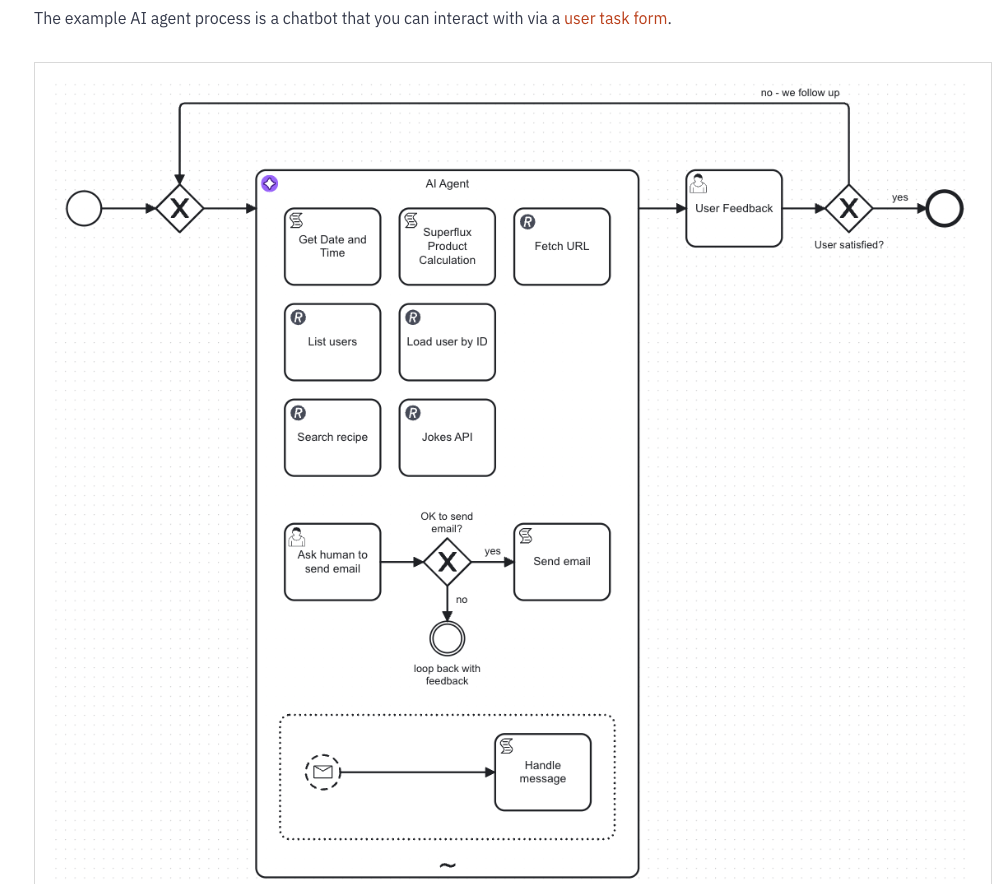
The most strategic aspect of this release lies in how Camunda is positioning itself for the world of artificial intelligence. This is not about AI as an add-on to automation, but about environments where agents make decisions autonomously.
This scenario introduces new challenges:
- Agents do not follow fixed flows
- Decisions are not predictable
- Responses are asynchronous
- Without an orchestration layer, this environment quickly becomes chaotic
Camunda 8.9 addresses this with three key pillars:
MCP Server (Model Context Protocol)
Enables agents to discover and use Camunda capabilities in a standardized way.
A2A (Agent-to-Agent)
Enables communication between agents, creating distributed collaboration scenarios.
Multi-agent orchestration
Allows coordination of decisions, responses, and flows across different agents and systems.
The shift toward agent-based systems represents a structural change in how software operates within organizations. Unlike traditional automation, where every step is predefined, agents act autonomously, making decisions based on context and learning. This significantly increases the complexity of the environment, making it impractical to manage these flows without a clear coordination layer. This is exactly where orchestration becomes indispensable.
Overall, it is fair to say that Camunda is not trying to be the AI itself, but rather positioning itself as the layer that enables AI to operate at scale, with control, governance, and predictability. This is where businesses generate greater outcomes and higher ROI.
Supported models
The AI Agent connector natively integrates with the leading model providers on the market, including Anthropic Claude and AWS Bedrock, with no additional configuration required. For teams already working with other solutions, the connector also supports any LLM that exposes an OpenAI-compatible API, which means the vast majority of models available today can be connected to your orchestrated processes.This flexibility matters in enterprise environments: it allows organizations to choose or change their AI provider without rewriting integration logic, keeping the orchestration layer stable while the AI ecosystem continues to evolve.
Governance as a requirement, not a differentiator
As processes become more dynamic and decisions increasingly involve AI, the need for governance grows significantly. Camunda 8.9 strengthens this with:
- Granular, task-level permissions
- Fine-grained access control via APIs and interfaces
- Centralized audit logging
But the impact goes beyond compliance. We are talking about:
- Observability of distributed processes
- Traceability of automated decisions
- The ability to explain what happened, when, and why
In regulated industries, this is not optional.
Without this level of control, advanced automation and AI initiatives struggle to move beyond the pilot phase.
Want to maximize the potential of Camunda in your organization, with greater ROI and scalability? Talk to our specialists.
Camunda 7 migration: from technical risk to strategic opportunity
Historically, migrating from Camunda 7 to 8 was seen as a significant challenge.
Camunda 8.9 changes this scenario. With improvements in migration tools, it is now possible to:
- Migrate running instances, including complex scenarios
- Automatically convert historical logs
- Preserve audit trails
- Adapt BPMN models with greater compatibility
But the most important point is that migration is no longer just a necessary upgrade—it becomes an opportunity to:
- Modernize architecture
- Reduce operational complexity
- Prepare the organization for new automation models
The main argument for delaying migration is starting to disappear.
What does this mean for the business?
When looking at the full scope of these changes, the impact goes beyond technology. For organizations, this represents:
- Greater speed: processes can be adapted more quickly, without rewriting complex logic
- Greater control: automated decisions become traceable and governable
- Greater adaptability: flows move away from rigidity and respond to context
- A foundation for innovation: the company gains a real foundation for AI and advanced automation initiatives
In practice, these gains directly impact critical business operations. Processes such as credit approval, customer service, or claims management become more responsive to context changes, reducing decision time and improving the quality of outcomes.
This not only improves operational efficiency but also directly impacts customer experience and the company’s ability to compete in increasingly dynamic environments.
The next step in automation has already begun
Companies that continue to treat automation as task execution will quickly face limitations. The new landscape requires:
- Coordination across distributed systems
- Integration between humans and agents
- Processes that adapt in real time
Orchestration is no longer just backend—it becomes the central element connecting strategy, operations, and technology. Camunda 8.9 is a clear step in that direction. And beyond adopting the technology, the challenge now is understanding how to use it strategically to generate real business impact.
Get in touch with us. Our experts will help you on this journey with Camunda.