
How to evolve legacy systems without compromising stability, compliance, and scale?
This is the focus of this blog, building on real-world perspectives from industry leaders navigating the modernization of core banking and payment infrastructures in a rapidly evolving landscape.
This article expands those insights into a more in-depth analysis, connecting them to broader industry shifts and highlighting their practical implications for organizations operating in financial services and payments.
Financial services in the real-time era
Financial services have entered a phase where speed is a baseline expectation.
Consumers have grown accustomed to instant interactions across digital platforms. Payments are expected to clear immediately, balances should update in real time, and services must remain continuously available. What was once considered advanced is now assumed.
This shift is particularly visible in payments. The rise of instant payment systems, digital wallets, and embedded financial services has redefined how value moves. Delays that were previously tolerated are now perceived as friction.
At the same time, operational complexity has increased. Financial institutions must handle:
- higher transaction volumes
- more sophisticated fraud patterns
- multi-channel interactions
- strict regulatory requirements
All of this happens simultaneously, and often in real time.
Many institutions are still operating on infrastructures designed for a different era, where batch processing, delayed reconciliation, and scheduled updates were acceptable.
The result is a growing disconnect between what the market expects and what existing systems can reliably deliver.
To explore more about services and innovations to boost results in banks and financial institutions, check out this page.
Modernization in banking: a survival strategy
Modernization has shifted from an improvement initiative to a fundamental requirement for competitiveness. For years, it was treated as a defined project. Organizations would allocate budgets, set timelines, and aim for a future “modern state.” That model no longer reflects the reality of how financial systems evolve.
Today, modernization operates as an ongoing capability. It is embedded in how institutions design architecture, prioritize investments, and respond to change.
This shift is driven by multiple factors:
- continuous changes in customer behavior
- increasing regulatory complexity
- rapid emergence of new financial products
- pressure from fintechs and digital-native competitors
In the context of payments, the impact is even more direct. Infrastructure decisions influence latency, authorization speed, fraud detection, and customer experience in real time.
What emerges is a new dynamic: the ability to evolve systems continuously becomes a competitive advantage in itself.
Organizations that treat modernization as a periodic effort tend to accumulate technical debt faster than they can resolve it. Over time, this limits their ability to launch new products, integrate with partners, and respond to market shifts.
Institutions that embed modernization into their operating model, on the other hand, create a foundation that supports sustained innovation.
Process orchestration is a great ally for financial institutions in this journey.
The Jenga problem: why payment and banking systems are so hard to change
One of the most persistent challenges in financial institutions goes beyond recognizing the need for modernization. It is necessary to act on it.
Legacy systems are deeply interconnected. Core banking platforms, payment processing, risk engines, and customer data layers often depend on each other in ways that are not always visible or fully documented.
This creates a structural tension. Changing one component can have unintended consequences across the entire system.
The analogy of a Jenga tower illustrates this well. Each block represents a system component. Over time, the structure becomes taller and more complex. Removing or modifying a single piece introduces uncertainty about how the rest will behave.
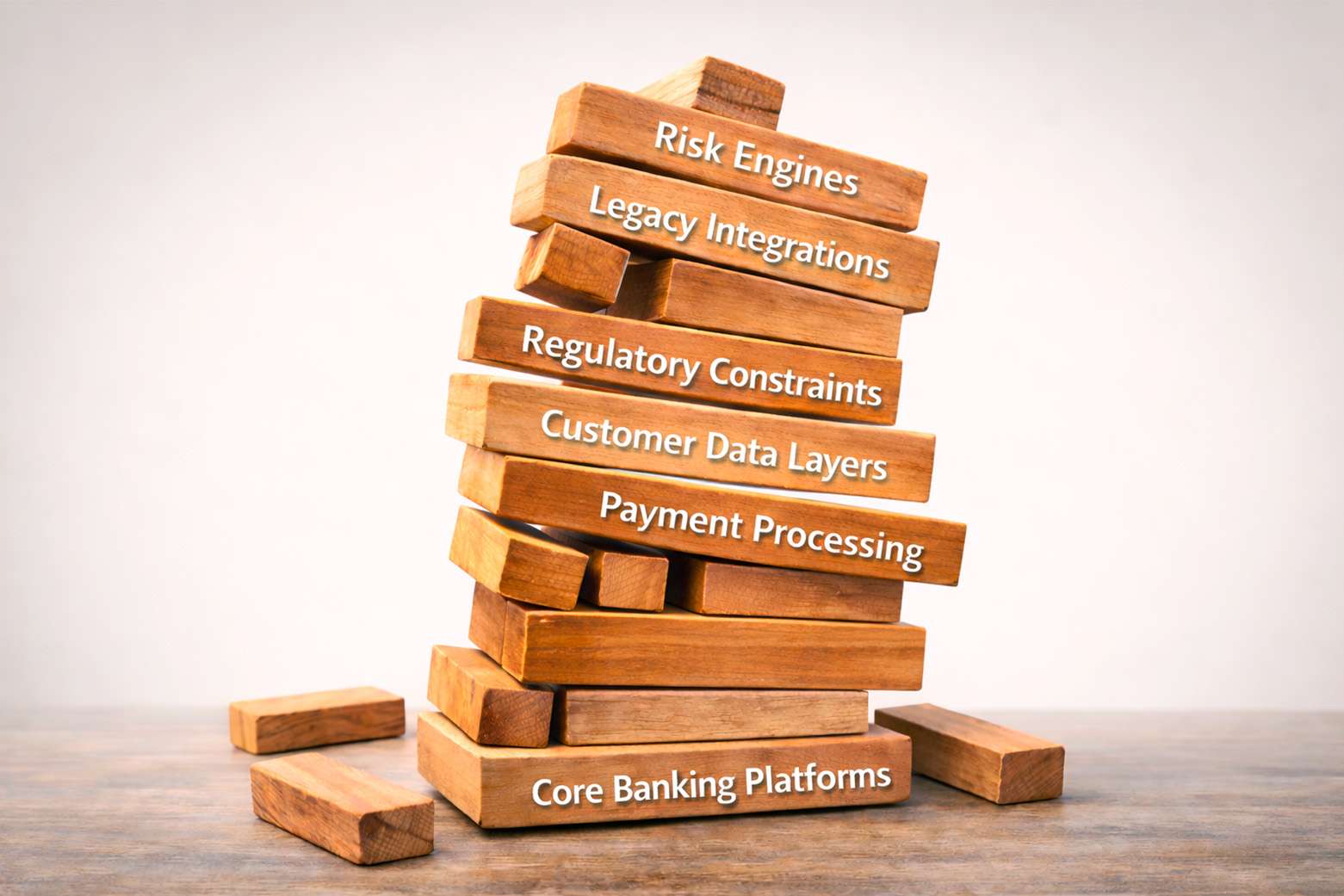
In financial services, that uncertainty carries real risk:
- transaction failures
- service outages
- compliance breaches
- reputational damage
As a result, organizations often adopt a cautious approach. Systems that are known to work, even if inefficient, are preserved. Over time, this leads to a form of operational inertia.
Additional barriers reinforce this dynamic:
- high cost and complexity of transformation
- conservative risk culture
- limited availability of modern engineering skills
The longer modernization is postponed, the more rigid the structure becomes. At the same time, external expectations continue to evolve, increasing the gap between current capabilities and required performance.
From Jenga to Lego: the rise of composable financial and payment architectures
Addressing this challenge requires a different architectural approach.
Instead of relying on tightly coupled systems, financial institutions are moving toward composable architectures. These are built around independent components that can evolve without affecting the entire system.
The contrast is clear:
- In a monolithic structure, changes propagate across multiple layers
- In a composable model, changes are localized and controlled
This is where the Lego analogy becomes useful. Each piece represents a discrete capability. Components can be added, replaced, or updated without destabilizing the overall structure.
In practical terms, this translates into:
- API-first design
- microservices-based architecture
- event-driven processing
- modular deployment strategies
For payments and financial services, this approach unlocks several advantages:
- faster product iteration
- easier integration with partners and ecosystems
- improved resilience and fault isolation
- ability to scale specific services independently
It also changes how organizations think about infrastructure. Instead of building large, all-encompassing systems, they assemble capabilities that align with business priorities.
This modularity is particularly valuable in environments where requirements evolve continuously, such as fraud prevention, real-time payments, and customer onboarding.
Modernizing without breaking: where financial institutions should start
A common misconception is that modernization requires a complete overhaul of existing systems. In practice, successful transformations tend to follow a more targeted and incremental path.
Rather than attempting to replace everything at once, institutions identify areas where change delivers immediate value and manageable risk.
In financial services and payments, these starting points often include:
- card issuing and processing
- payment authorization flows
- customer onboarding journeys
- fraud detection mechanisms
These domains share a common characteristic: they have a direct impact on customer experience and operational efficiency.
By focusing on these areas, organizations can introduce modern capabilities while maintaining stability in the broader system.
This approach offers several advantages:
- reduced implementation risk
- faster time to value
- ability to validate new architectures in production environments
- gradual evolution of internal capabilities
It also allows teams to build confidence. As new components prove reliable and effective, the scope of modernization can expand.
Over time, this creates a transition from isolated improvements to a more cohesive and adaptable architecture.
What changes in practice: real-time payments, fraud prevention, and operational scale
The impact of modernization becomes evident when looking at how systems operate on a day-to-day basis.
One of the most visible changes is the shift to real-time processing. Transactions are authorized, recorded, and reflected in customer balances instantly. This eliminates delays that previously affected user experience and operational workflows.
In payments, this enables scenarios such as:
- instant issuance of virtual cards
- immediate availability of funds
- seamless integration with digital wallets
Fraud prevention also evolves in this context. Instead of analyzing transactions after they occur, systems can evaluate risk before authorization. This allows institutions to prevent fraudulent activity rather than react to it.
Security, in this model, becomes embedded in the transaction flow itself. Risk assessment, anomaly detection, and decision-making happen in real time, as part of the execution layer. This reduces exposure while preserving speed and customer experience, which is critical in high-volume payment environments.
Operationally, modern architectures support continuous availability. Systems are designed to remain online, with updates deployed incrementally rather than through scheduled downtime.
Scalability becomes more dynamic as well. Infrastructure can adjust to fluctuations in demand, such as peak transaction periods, without compromising performance.
These changes are not isolated improvements. They reshape how financial services are delivered, aligning system behavior with real-world expectations while reinforcing resilience and trust at scale.
The future of financial infrastructure: real-time, composability, and AI-driven trust
Looking ahead, several trends are shaping the next generation of financial infrastructure.
The first is the expansion of real-time capabilities across all layers of the system. What began with payments is extending into areas such as lending, risk management, and customer data processing.
The second is the continued adoption of composable architectures. As ecosystems grow more complex, the ability to assemble and reconfigure capabilities becomes increasingly valuable.
The third is the role of artificial intelligence in building trust. Fraud detection, anomaly identification, and predictive analysis are evolving from support functions into core differentiators.
In this context, trust is not only a compliance requirement. It becomes a competitive asset. Institutions that can demonstrate reliability, security, and transparency gain a stronger position in the market.
The convergence of these trends points to a broader shift. Financial infrastructure is moving toward models that are:
- continuously evolving
- inherently scalable
- tightly aligned with business outcomes
We discussed these topics in a recent NT Talks episode with Rutger van Faassen from Pismo, now part of Visa.
The full episode is available on Spotify in English. Listen here:
Sustaining this evolution requires more than adopting new technologies. It depends on how organizations structure decisions, develop capabilities, and integrate innovation into their core operations.
Institutions that embrace this model build systems that adapt without disruption. Those that do not face increasing constraints as the pace of change accelerates.
Choose the Right Technology Partner for This Journey
NTConsult supports financial institutions in modernizing their architectures, orchestrating critical processes, and building scalable, resilient, and results-driven solutions.
With over 20 years of market experience, we combine software engineering, data, automation, and artificial intelligence to transform complexity into operational efficiency and competitive advantage.
If your organization is facing challenges in evolving legacy systems, enabling real-time capabilities, or structuring a more flexible and future-ready architecture, it’s worth having a conversation with our team.
Let’s talk. We can support your modernization journey with security, scale, and real impact.